
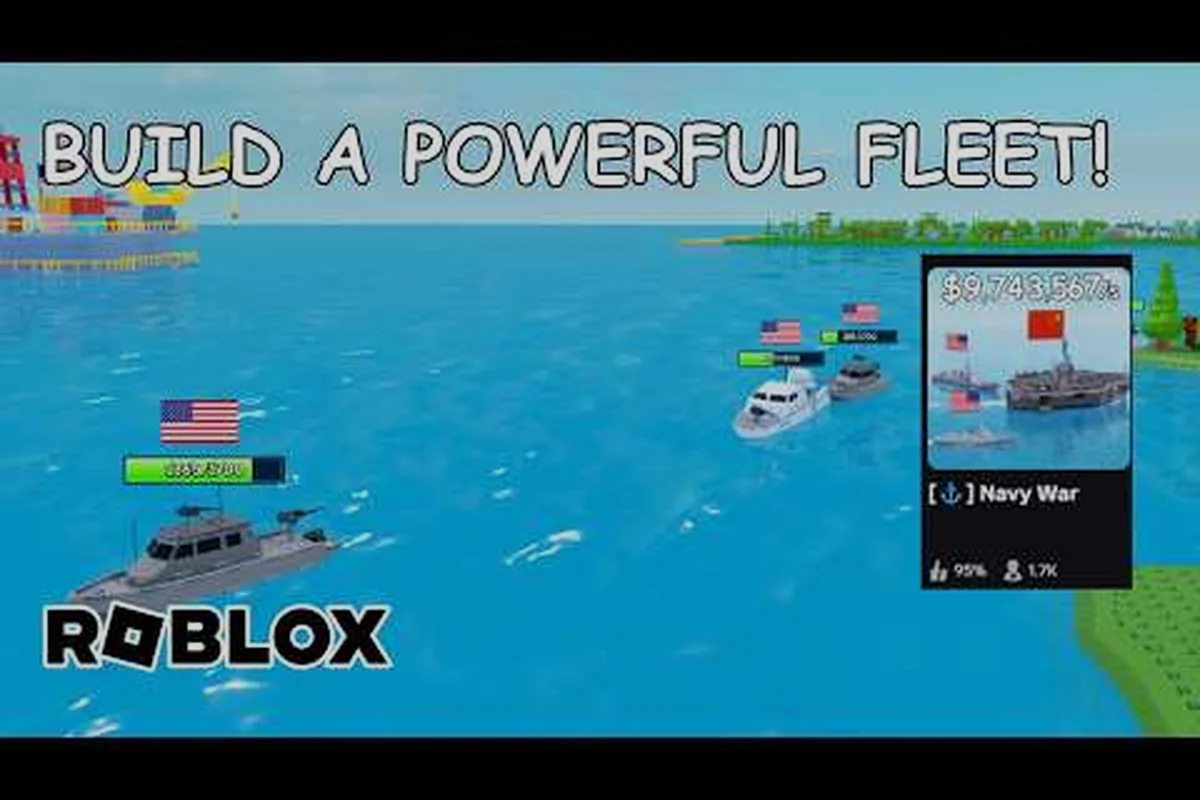
Picking the Navy War best ship for PvP combat comes down to matching your hull class to the fight you actually want, not chasing the biggest gun on the dock. Heavy cruisers trade speed for punishing armor, light cruisers slip into flanks with rapid reloads, and stealth submarines end duels before the enemy even locks on. This guide breaks down the heavy cruiser review, the light cruiser review, and the stealth submarine tactics that decide most PvP outcomes on the open water.
Navy War Hull Types Explained
Before you commit steel to a build, you need a clear picture of the Navy War hull types explained through the game's own role design. Every ship class in Navy War, the Roblox strategy title by Parabola MMOVEMENT, slots into one of three combat identities, and the Navy War ship armor mechanics underneath each hull determine who wins a straight exchange.
Heavy, Light, and Stealth Hull Identity
The three PvP-relevant hull families each answer a different question on the battlefield. Heavy cruisers are anchor ships that soak damage, hold a cap point, and punish brawlers who stay in their firing arc too long. Light cruisers are mid-speed glass cannons built for kiting, hit-and-run volleys, and supporting destroyers with rapid secondaries. Stealth submarines operate below the detection curve, relying on sonar stealth, surprise torp angles, and ambush windows to collapse on distracted targets.
The official Navy War on Roblox page lists the core naval classes — Destroyer, Cruiser, Battleship, Submarine, and Aircraft Carrier — and confirms that fleet composition is a core strategic layer. For PvP specifically, cruisers and submarines are the two classes that show up most often in player-reported competitive lineups, because their kit design rewards positional play more than raw tonnage.
How Armor, HP, and Detection Interact
The Navy War ship armor mechanics system layers three defensive stats — base HP, armor value, and detection range — and the relationship between them decides who can even shoot at whom. A heavy cruiser with high armor and large HP pool will absorb light-cruiser HE shells for sustained trades, while a light cruiser's lower armor means every hit counts but its speed and reload let it dictate range. Stealth subs lower their detection radius when submerged, which lets them close to torpedo distance without being painted, but they pay for it with brittle armor and limited HP.
Understanding this triangle lets you stop asking "what is the best ship" and start asking "what is the best ship for this matchup," which is the real question behind finding the Navy War best ship for PvP combat. A heavy cruiser piloted against a low-detection stealth sub will never close the detection ring and is forced to kite, while the same heavy cruiser deleting light cruiser citadels at 12 km can snowball a flank before destroyers reposition. Matchup-specific loadouts — AP-only ammo racks for cruiser duels, torpedo reload boosters for sub-hunting, radar consumables to strip sub concealment — turn a generic tier list into a ranked-counter decision tree that rewards map reading over raw stats.
Navy War Heavy Cruiser Review
The Navy War heavy cruiser review opens with a blunt truth: if your base gets rushed and you need a ship that can stand in a chokepoint and not crumble, this is your class. Heavy cruisers pair thick belt armor with large-caliber main batteries, and the better you understand their defensive profile, the more reliably you can hold a PvP lane.
Defensive Profile and Brawling Window
A heavy cruiser's defensive ceiling comes from a stacking multiplier between HP and armor, while its offensive window is gated by turret traverse and reload. According to community data aggregated from the Navy War game page and player-reported testing, heavy cruisers can typically absorb 2-3 sustained volleys from a light cruiser before HP drops to a critical threshold, which gives the player a generous window to land retaliatory salvos.
The trade-off is mobility. Heavy cruisers are slow to reposition, which means kiting compositions will dodge your shells and your escape routes are limited. Treat the heavy cruiser as a zone-control ship: pick a cap, anchor on it, and force the enemy to either commit into your firing arc or leave the objective uncontested.
| Heavy Cruiser Strength | Heavy Cruiser Weakness | PvP Best Use |
|---|---|---|
| Highest armor value in cruiser class | Slowest top speed among cruisers | Holding a capture point |
| Large-caliber main battery alpha strike | Long turret traverse arc | Brawling enemy destroyers |
| High HP pool for sustained trades | Weak against coordinated submarine flanks | Pushing a defended chokepoint |
| Strong bow/stern armor when angled | Vulnerable to long-range HE spammers | Countering light cruiser flanks |
Matchups and Firing Discipline
Against other heavy cruisers, you win by angling — keeping your bow toward the enemy so the thickest armor section eats incoming shells, while your own broadside waits for the traverse to come around. Against light cruisers, you want to keep them at medium range where their lower alpha cannot one-shot your armor, and where your heavier shells still land reliably. Against submarines, you must rely on your team's escort destroyers or active sonar, because your slow turning circle makes dodging torps nearly impossible.
For a deeper breakdown of how heavy cruiser armor numbers stack up against battleships and destroyers, the Navy War ship stats comparison guide covers the full tier math in detail — including belt-thickness vs. HE-penetration breakpoints, citadel hit-chance percentages at 8 km vs. 14 km, and how destroyer SAP alpha interacts with cruiser plating after the armor-rework patch, which is the single biggest factor deciding whether a heavy cruiser can actually hold a flank or has to fall back behind the battleship line.
Navy War Light Cruiser Review
The Navy War light cruiser review flips the script: instead of soaking damage, you are spending it. Light cruisers are the PvP skirmishers — fast, fragile, and lethal when their reload cadence lines up. They are the most mechanically demanding class in the game because every engagement is a positioning puzzle.
Kiting, Reload, and Flank Control
A light cruiser's job is to never be where the enemy expects you. With higher base speed than heavy cruisers and a meaningfully faster reload, you can land three salvos for every two a heavy cruiser fires, but each of your shells does less damage per hit, so missing is expensive. The kiting pattern is the core skill: open fire at max range, reverse away as the enemy closes, and use your speed advantage to maintain a band where your guns can track but theirs cannot.
Light cruisers also dominate in flank routes. Most players instinctively push down the center of a map, which means the side channels are often uncontested, and a light cruiser that swings wide can hit the enemy's broadside from angles they are not armored for. This is also where the class feeds into team play — your rapid volleys strip armor off heavies so your team's battleships can finish the kill.
| Light Cruiser Strength | Light Cruiser Weakness | PvP Best Use |
|---|---|---|
| Highest top speed among cruisers | Lowest HP pool of any cruiser | Flanking maneuvers |
| Fastest reload cadence | Glass-cannon armor profile | Anti-destroyer escort duty |
| Best-in-class acceleration | Smaller main battery caliber | Kiting heavy cruisers at range |
| Strong torpedoes on some variants | Vulnerable to focused fire | Scouting and spotting for subs |
Common Light Cruiser Mistakes
The most common failure mode is overcommitting. Light cruisers reward players who disengage at 60% HP, because their value comes from staying alive across multiple engagements. A light cruiser that burns its HP pool in the first minute of a match has nothing left to contribute in the closing fight. The second most common mistake is fighting on the enemy's terms — if a heavy cruiser has angled up and is holding a cap, do not brawl them head-on, swing around and punish their rear turret rotation instead.
Navy War Stealth Submarine Tactics
The Navy War stealth submarine tactics layer is where matches are actually decided, because a single well-placed torpedo volley can swing a duel that looked unwinnable ten seconds earlier. Subs are not brawlers; they are ambush predators, and the entire kit is built around closing the gap unseen.
Sonar, Detection Bubbles, and Ambush Windows
A submarine's detection radius shrinks significantly when submerged, which means the core skill is reading the surface detection bubble and slipping past it. According to community testing reported across player guides, a submerged sub can typically close to within a third of the open-water detection range before being painted, which is enough to line up a torpedo spread on a broadside target.
The optimal ambush window is when an enemy cruiser is focused on a brawl and has stopped adjusting course. At that moment their AAA is split, their rudder is hard over, and a torpedo spread from below catches them perpendicular — the worst possible angle to dodge. The stealth window between when you fire and when the torps arm is also when you are most vulnerable, so firing from maximum tube range and immediately diving deep is the standard evasion play.
| Stealth Submarine Strength | Stealth Submarine Weakness | PvP Best Use |
|---|---|---|
| Lowest detection radius when submerged | Lowest HP pool of any PvP class | Ambush on engaged targets |
| High-alpha torpedo volleys | Slow surface speed | Flanking around island cover |
| Silent approach on radar | Cannot contest caps alone | Finishing low-HP fleeing targets |
| Surprise factor in late game | Weak in straight 1v1 against depth-charge escorts | Decap-strike on undefended objectives |
Anti-Sub Counterplay to Watch For
A smart enemy will keep a destroyer or a depth-charge-equipped escort near their backline specifically to deny sub angles. When you see a destroyer holding close to a heavy cruiser, that lane is baited and you should not commit. Instead, hunt the unescorted flanks or wait until the destroyer peels to chase a torpedo boat, then strike the cap it left unguarded. Patience is the entire sub kit in a single word.
If you are still building out your roster and want to know how submarine hulls compare to the rest of the tree, the Navy War all ships list reference breaks down every unlockable class with progression notes.
Armor Mechanics and the Matchup Triangle
The Navy War ship armor mechanics system is what makes the heavy-light-stealth triangle feel like a genuine rock-paper-scissors rather than a linear power curve. Once you see the armor numbers as a relationship rather than a ranking, choosing the Navy War best ship for PvP combat becomes a matchup question rather than a tier question.
Reading Armor Values in the Loadout Screen
Every ship in the loadout screen lists three defensive values: HP, armor, and detection. The pattern is consistent across classes — heavy cruisers have the highest HP and armor, light cruisers have the lowest armor but compensate with speed, and submarines have a uniquely low surface detection that drops further when submerged. Reading these three numbers side by side tells you immediately how the ship wants to play, and it tells you immediately which enemy classes it can and cannot brawl.
Translating Armor Into Engagement Rules
A clean way to internalize the triangle: heavy beats light in a held brawl, light beats heavy in a kiting chase, and stealth beats both when the ambush connects. None of those outcomes is guaranteed — a heavy that catches a kiting light at close range still wins, a light that lands a full broadside volley on a heavy still chunks meaningful HP, and a sub that surfaces into a destroyer still dies — but the directional logic holds for most unforced engagements.
| Matchup | Winner When Played Correctly | Loser If Caught Out of Position |
|---|---|---|
| Heavy Cruiser vs Light Cruiser | Heavy at medium range, kited | Light at close range, broadside-on |
| Light Cruiser vs Stealth Submarine | Light with active sonar ping up | Light caught alone, no escort |
| Stealth Submarine vs Heavy Cruiser | Sub from below, torpedo broadside | Sub on surface, no cover |
| Heavy Cruiser vs Stealth Submarine | Heavy with destroyer escort | Heavy alone, no sonar coverage |
| Light Cruiser vs Light Cruiser | Whoever kites better | Whoever reloads slower |
| Stealth Submarine vs Stealth Submarine | First to detect the other | Second to surface |
If you want a fuller look at how speed numbers and reload cadences feed into these matchups, the Navy War ship speed comparison guide has the per-hull movement profiles charted out, including burst-vs-sustained acceleration, rudder lock time, and how each hull's reload window lines up against torpedo approach vectors. That matters because the table above only shows who wins in an idealized duel — in practice, a Heavy Cruiser sitting at 14 knots with a 9-second reload will lose to a Light Cruiser kiting at 22 knots unless the heavy can force a same-speed gun angle inside 8 km, which is exactly the kind of breakpoint the speed comparison page quantifies per hull.
Frequently Asked Questions
What is the Navy War best ship for PvP combat overall?
There is no single best ship — the Navy War best ship for PvP combat depends on the matchup triangle between heavy cruisers, light cruisers, and stealth submarines. Heavy cruisers win held brawls, light cruisers win kiting duels, and stealth submarines win ambushes from below, so the "best" pick is whichever hull class answers the enemy lineup you are facing.
Is the heavy cruiser worth the slow speed?
Yes, the heavy cruiser is worth the slow speed in any objective-based PvP mode because its armor and HP let it anchor a capture point that lighter ships cannot hold. You will lose open-water chases against light cruisers, but you will win the lane that actually scores the round, which is the trade-off that makes the heavy cruiser a top-tier PvP pick.
How do I unlock the light cruiser in Navy War?
You unlock the light cruiser by progressing through the early dock tiers and completing the cruiser research node, which usually takes a few hours of active fleet management on a fresh base. The full unlock path is covered in the Navy War how to unlock cruiser walkthrough, which lists the resource thresholds in order.
When should I bring a stealth submarine instead of a cruiser?
Bring a stealth submarine when the enemy team has at least one brawling heavy cruiser and you do not have a coordinated destroyer escort on your side. The sub's ambush potential on an engaged heavy is the single highest-leverage opening in the game, and it punishes teams that over-commit to cap fights without screening their flanks.
Do armor-piercing rounds beat the heavy cruiser's belt armor?
Armor-piercing rounds beat the heavy cruiser's belt armor only at close range with a flat angle hit, which is rare in PvP because players learn to angle. Against angled heavies, switch to HE shells if your class has them, or reposition for a broadside shot, because chip damage from HE on flat broadside plates outperforms AP that glances off angled belt sections.